Welcome to Scooby's Prehistory Archives!
Backyard Mastodons: Three Great Specimens!
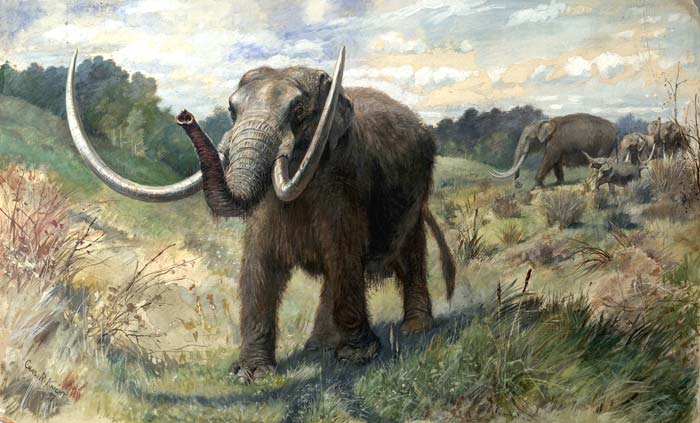
The American mastodon (Mammut americanum) is one of the most renowned extinct Cenozoic animals of North America, garnering fame and attention since first being discovered all the way back in the 1700s. At one point interpreted as biblical giants, it was eventually made clear that the giant bones found in America were some sort of elephant. Or so they thought. While both proboscideans, mastodons are actually not elephants! Elephants are the animals within the family Elephantidae (including modern elephants and mammoths), while mastodons are within the family Mammutidae. This family, including Mammut itself, went extinct about 11,000 years ago, in the beginning of the Holocene. The two groups have key differences in their molars, tusks, and overall body plans, but that is a story for another day! In the meantime, we should explore three famous mastodon specimens, examples which helped shape our understanding of these magnificent beasts. These are three mastodons, housed in Cambridge, MA, New York, NY, and Ithaca, NY, that I also consider my personal favorites.
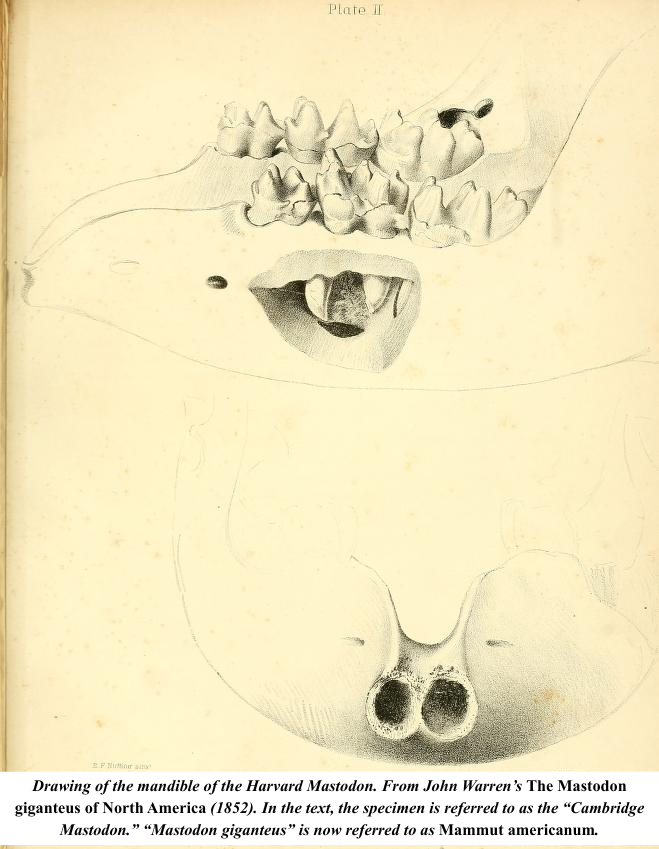
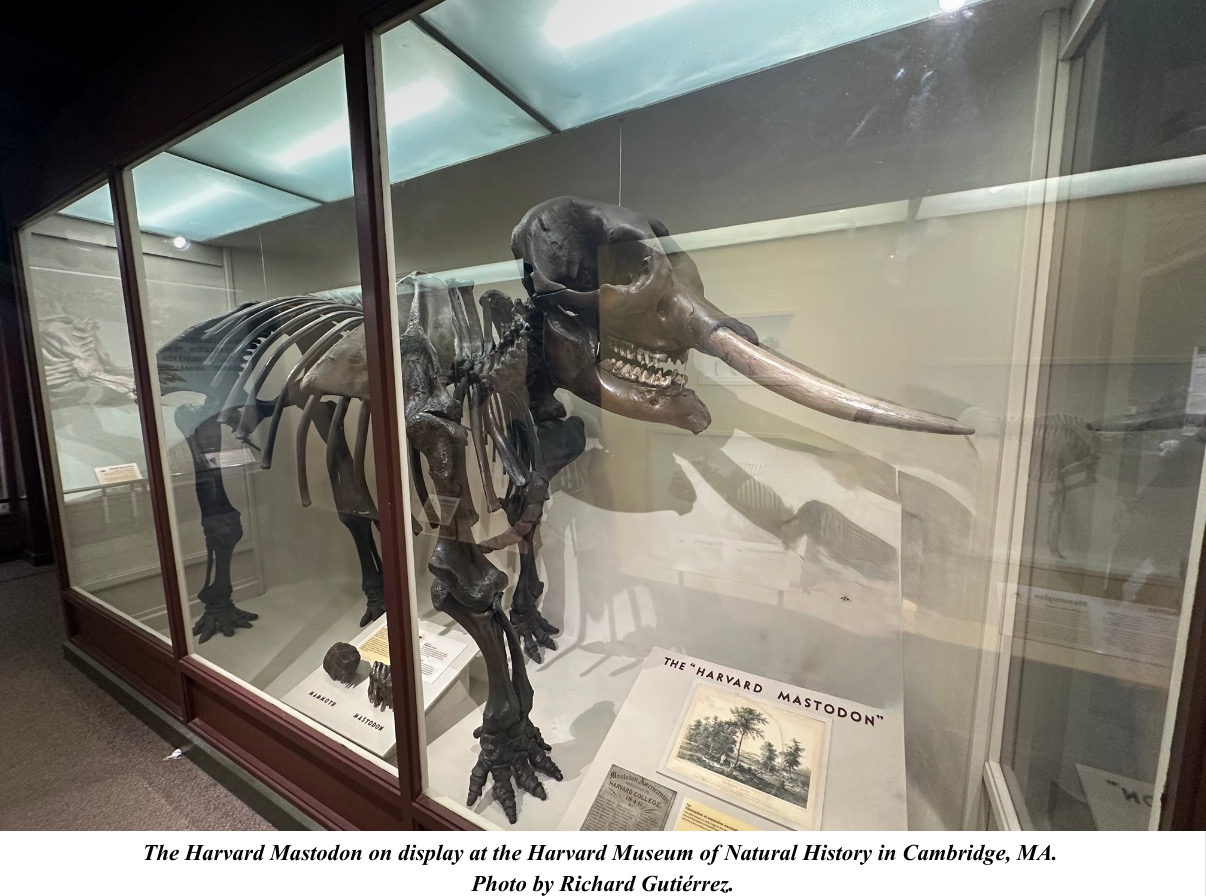
Starting off in Massachusetts is the appropriately-named “Harvard Mastodon.” It is a mastodon, and it is housed at the Harvard Museum of Natural History. It has been held by Harvard since the mid 1800s, originally unearthed in 1844 from a locality in New Jersey. Back then, it was referred to as the now-incorrect name Mastodon giganteus. Despite this antiquated scientific name, the Harvard Mastodon is frankly diminutive for a Mastodon. What it lacks in size, it more than makes up for in completeness. According to a Dr. J. B. S. Jackson at a meeting for the Boston Society of Natural History, only feet bones, the sternum (chest bones), and some caudal (tail) vertebrae are missing. According to Jackson, the smaller size and shortened tusks point towards the fact that this skeleton represents a young adult, and likely a female. It is now referred to as Mammut americanum.
The Harvard Mastodon was presented to Harvard College, specifically, in 1846 by a large group of men from Boston and nearby cities. One name on the list, hailing from Cambridge, is John Webster. He was a chemistry lecturer who had a reputation of being frivolous with spending. In fact, one such example is the Harvard Mastodon itself, which he bought (on credit) for $3,000, equal to over $120,000 today. Another Boston-area man, the wealthy real estate tycoon George Parkman, confronted Webster regarding a debt in 1849. In the argument, Webster struck Parkman in the head, killing him. This case is an infamous part of Harvard’s history, and the Harvard Mastodon still stands at the museum as a reminder of both a magnificent animal and a not-so-magnificent event.
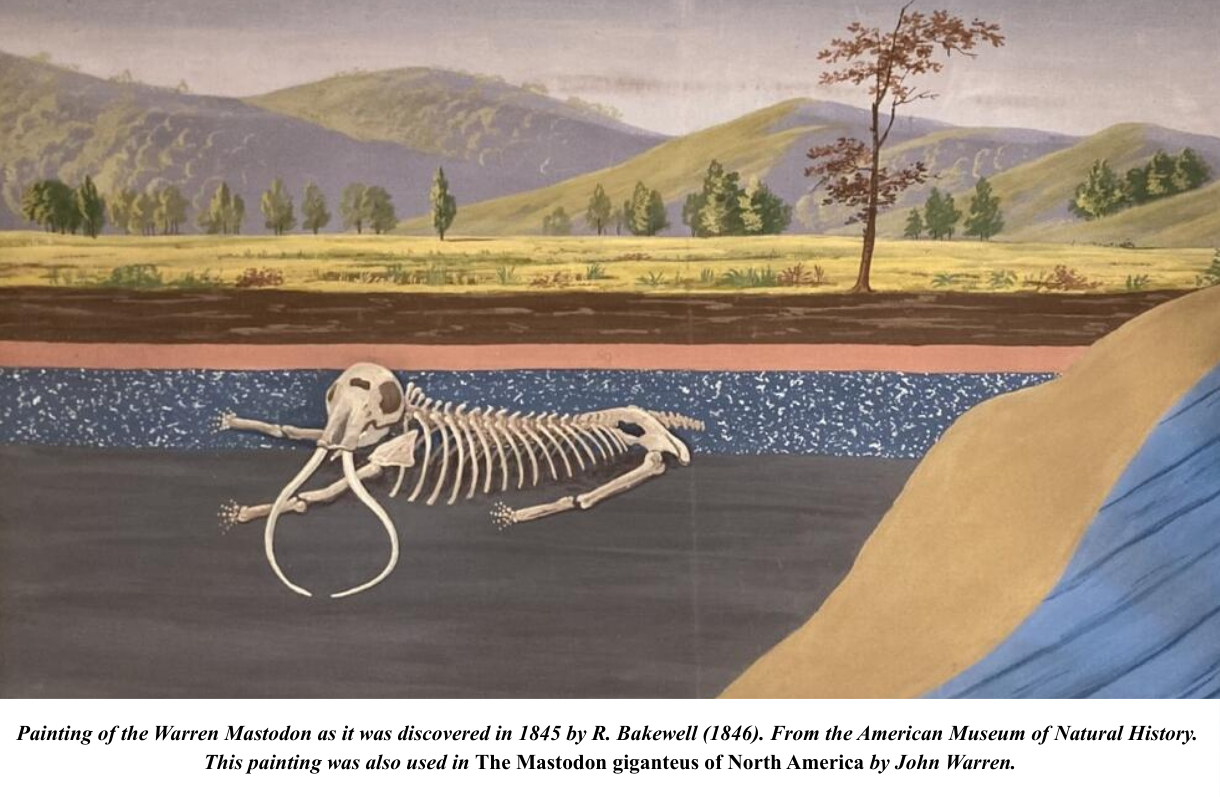
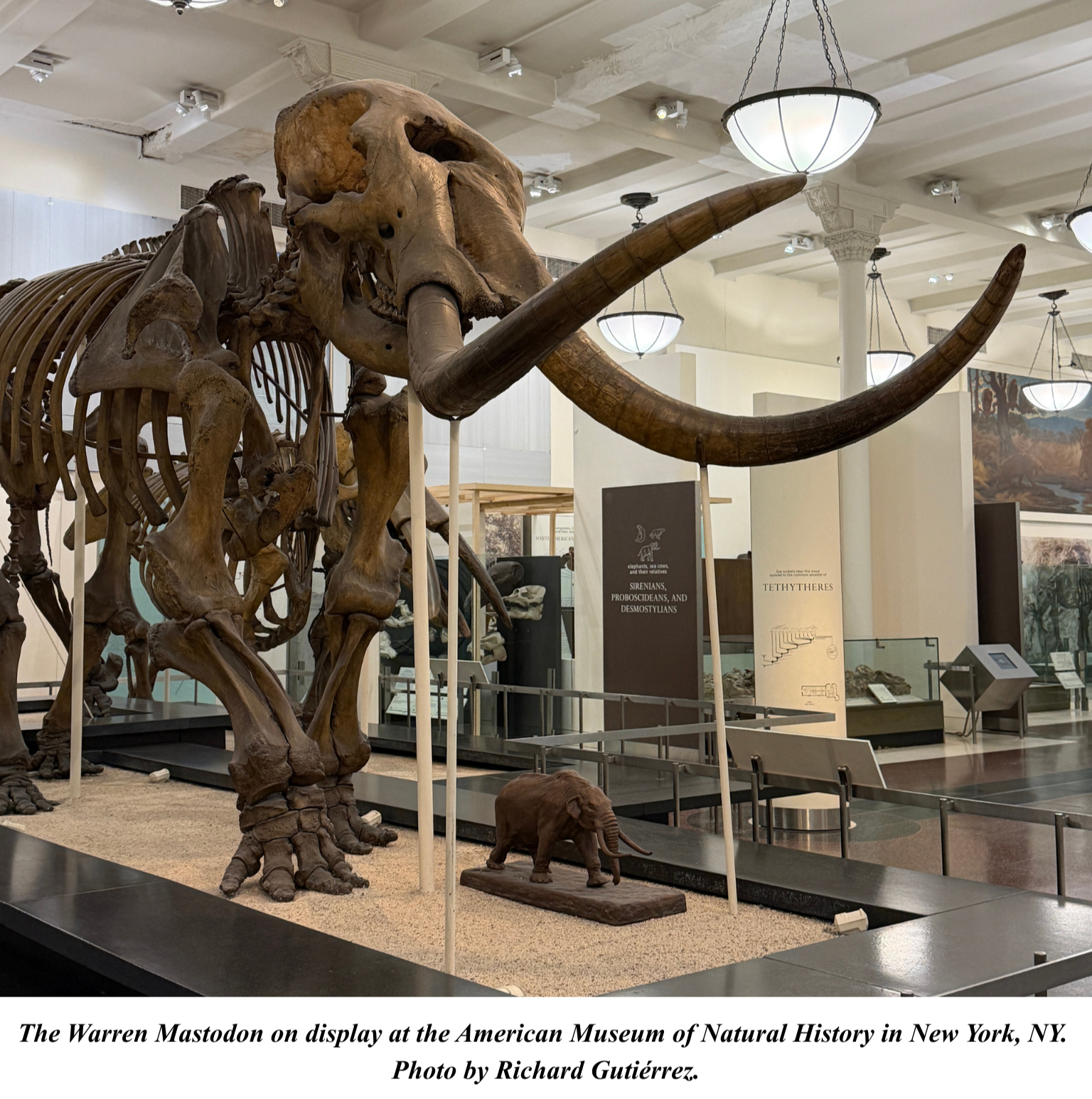
The next Mastodon is on display in New York, NY, at the American Museum of Natural History (AMNH). Displayed in the museum’s Hall of Advanced Mammals, it is right next to its distant cousin, the woolly mammoth, and to another cousin, a Gomphotherium. This mastodon, known as the “Warren Mastodon,” was originally discovered in Newburgh, NY, in 1845. It is even closer to completion than the Harvard Mastodon is, only missing a few toes and caudal vertebrae. In fact, it is widely considered as the first virtually-complete mastodon specimen. It was so well preserved that some impressions of its intestines were evident when discovered, material that is still housed within the AMNH’s mammal collections. Its name is also fitting, as it was originally housed at a Boston museum founded by John Warren. By 1906, it had been moved to the AMNH, along with much of Warren’s other fossils.
A common theme in many excavated Mammut specimens is the frailty of the tusks; with the Warren Mastodon, for example, they began to deteriorate almost instantly after being unearthed. The original tusks were stored, and papier-mache replicas- albeit too long- were produced by Warren’s staff. When the AMNH acquired the bones, however, they were able to recreate the tusks at the proper length and positioning within the skull sockets. Even more interestingly, they used growth rings in the tusks to estimate the animal’s age, which was around 30 years old when it died. Today, it stands at the AMNH as one of the most eye-catching prehistoric mammal exhibits.
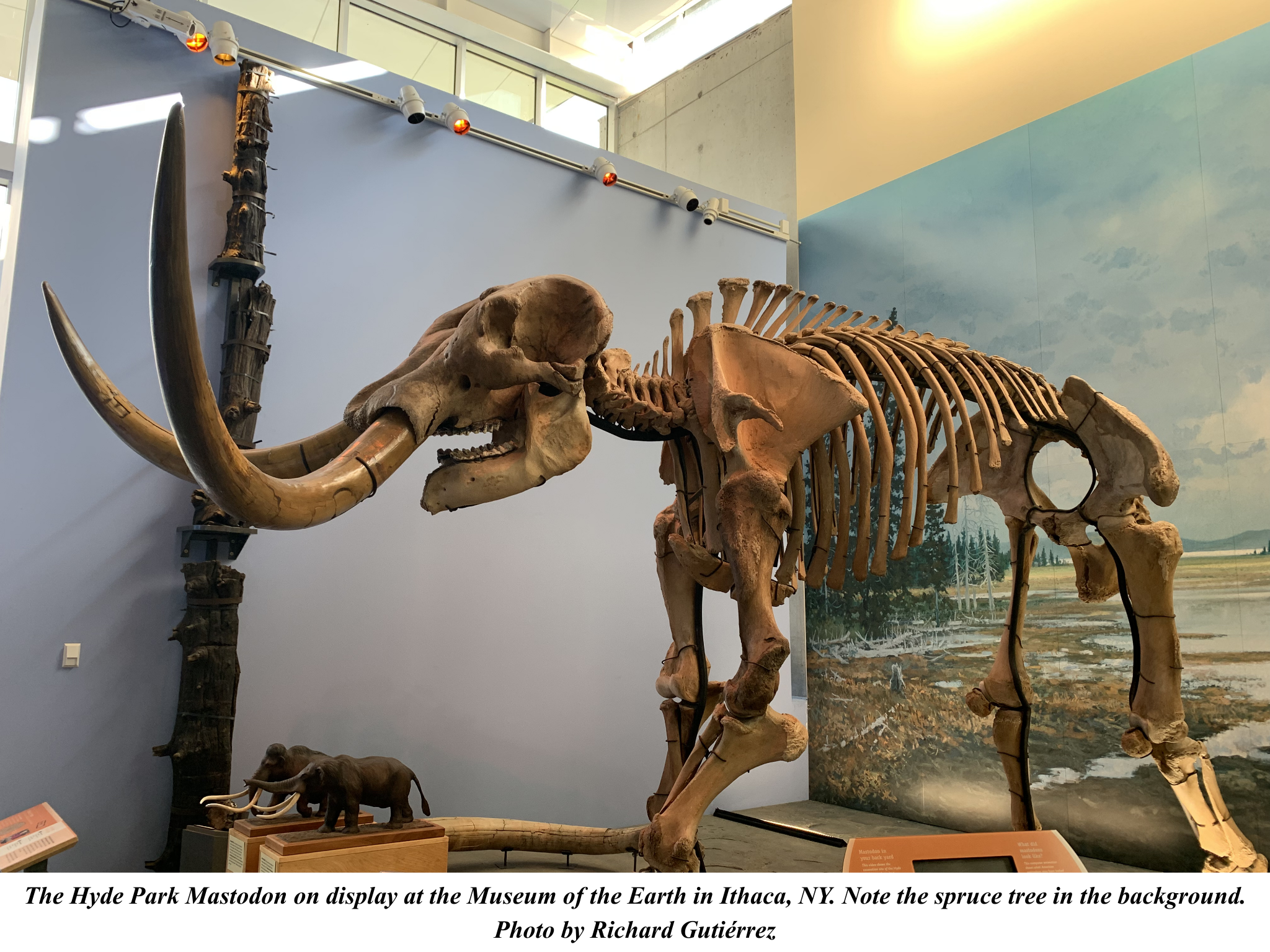
Finally, another New York state mastodon: the “Hyde Park Mastodon,” housed at the Museum of the Earth in Ithaca, NY. Another aptly named specimen, this very large and very complete Mammut was found in Hyde Park, a town in New York’s Hudson Valley. Specifically, it was found in a pond right by a homeowner’s house, causing quite the stir. In fact, the Hyde Park Mastodon and its discovery is featured in an episode of Discovery Channel’s The Ultimate Guide titled, “Mastodon in Your Backyard.” Based on this mastodon’s tusk growth rings, it was around 36 years of age at the time of its death. Additionally, according to Warren Allmon, director of the museum, it likely died in the spring or summer time.
Almost as interesting as the mastodon itself is what was found alongside it. Specifically, a white spruce tree, which was possibly deposited around the same time as the proboscidean, was also found in the pond. Through examination of the tree rings, it was clear that there were some cyclic stressors to the tree, perhaps droughts or temperature fluctuations. Wider tree rings imply more favorable growth conditions, while thinner rings betray more stressful times for the plant. The species of the tree itself is still extant, but lives much further north than Hyde Park, signifying that overall temperatures were cooler over 10,000 years ago. This sort of analysis is called a paleoproxy. That is, tree rings can provide rough insights on climate and prehistoric environments. However, according to Rob Ross, also from the Museum of the Earth, different paleoproxies (and even lots and lots of tree ring data) can be used in unison to paint an even clearer picture of ancient ecosystems. In fact, paleoproxies are what the team studying the Hyde Park Mastodon used to determine that it likely died in the spring or summer seasons.
The American mastodon is one of the most recognizable prehistoric mammals. This claim is particularly clear when visiting the three specimens explored here. Standing in front of each and every one of these filled me with wonder and awe. The thought of these spectacular beasts roaming America thousands of years ago is an emotional one, as is the imagined “what-if” of a continent with still-living mastodons. Of these three, my personal favorite is the Hyde Park Mastodon, as I was fortunate enough to see the beast on a near-weekly basis at one point. They are all humbling reminders of what once used to traverse through our own backyards.
Dedicated to Beast

Sources:
Allmon, Warren. “The Hyde Park Mastodon, 13,000 + 20 Years Later.” Paleontological Research Institution, 16 Sept. 2020, www.priweb.org/blog-post/hyde-park-mastodon.
Cabot, Samuel. “Dr. Samuel Cabot, Jun., in the Chair.” Proceedings of the Boston Society of Natural History, vol. v.2 (1848), 1 Oct. 1845, pp. 60–62, www.biodiversitylibrary.org/item/37031#page/68/mode/1up.
Museum of Comparative Zoology. “Taxon Details | MCZbase.” Harvard.edu, 2026, mczbase.mcz.harvard.edu/name/Mastodon%20americanus. Accessed 19 Feb. 2026.
Museum of the Earth. “Hyde Park Mastodon.” Museum of the Earth, 3 Jan. 2020, www.museumoftheearth.org/exhibit/hyde-park-mastodon.
Naunton, Maya. “The Story of the Warren Mastodon | AMNH.” American Museum of Natural History, 17 Oct. 2022, www.amnh.org/research/research-library/library-news/warren-mastodon-archive.
Paiva, Walter. “The Murder of Dr. George Parkman | Magazine | the Harvard Crimson.” Thecrimson.com, 9 Mar. 2017, www.thecrimson.com/article/2017/3/9/dial-m-for-mastadon/. Accessed 19 Feb. 2026.
Ross, Robert. Paleoproxies: Estimating Ancient Environments. EAS 1700: Evolution of the Earth and Life.
Photo Sources:
https://www.amnh.org/research/research-library/library-news/warren-mastodon-archive
https://www.biodiversitylibrary.org/page/40681278#page/10/mode/1up
https://commons.wikimedia.org/wiki/File:Knight_Mastodon.jpg
All other photos taken by Richard Gutiérrez


Subscribe to Scooby's Prehistory Archives
Never miss a new chance to learn about prehistory!
Copyright 2026. Richie The Dino. All Rights Reserved.