
Welcome to Scooby's Prehistory Archives!
The OTHER Camel(id)s
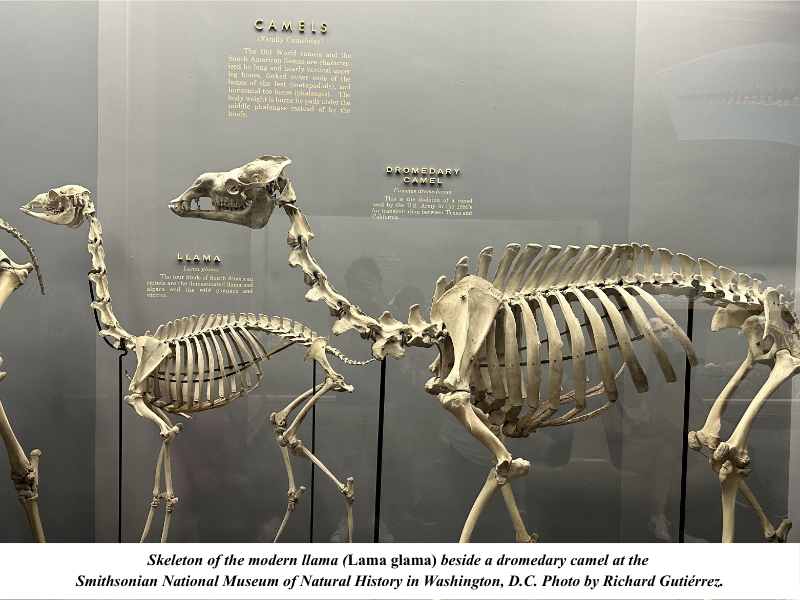
On this blog, we’ve talked about the precursor to the Old World camels, Paracamelus. But what of the South American camelids, the llamas? Camelidae and their early relatives originated in North America over 45 million years ago, many millions of years before North and South America connected together through what is now Panama. In the meantime, the family diversified into a few different subfamilies; for our purposes, the extant Camelinae is of note. Camelinae is further split into the tribes Camelini, which includes the Old World camels and Paracamelus, and Lamini, which includes the South American llama, alpaca, guanaco, and vicuña. So Lamini originated in North America, just as Camelini did. To learn about some notable North American Lamini genera, as well as the trailblazing lamines who migrated south after the closure of the Panamanian isthmus.
According to Honey et al., the two tribes diverged roughly 15 million years ago. However, this estimate is not certain due to the taxonomic status of some camels. Take Aepycamelus, for instance. Originally referred to as a Camelini, it is now more frequently aligned with Lamini, albeit with minimal certainty. Honey et al. themselves, in 1998, placed the genus within Lamini while still recognizing the possibility that Aepycamelus may, in fact, be ancestral to both tribes. This mystery is not helped by the fact that genetic analysis of Camelus ferus (wild Bactrian camel) supports a date of divergence of around 25 million years ago. For our purposes, the exact date of divergence does not matter, and we can treat Aepycamelus as an early member of Lamini (or, at least, an early ancestor of modern lamines).
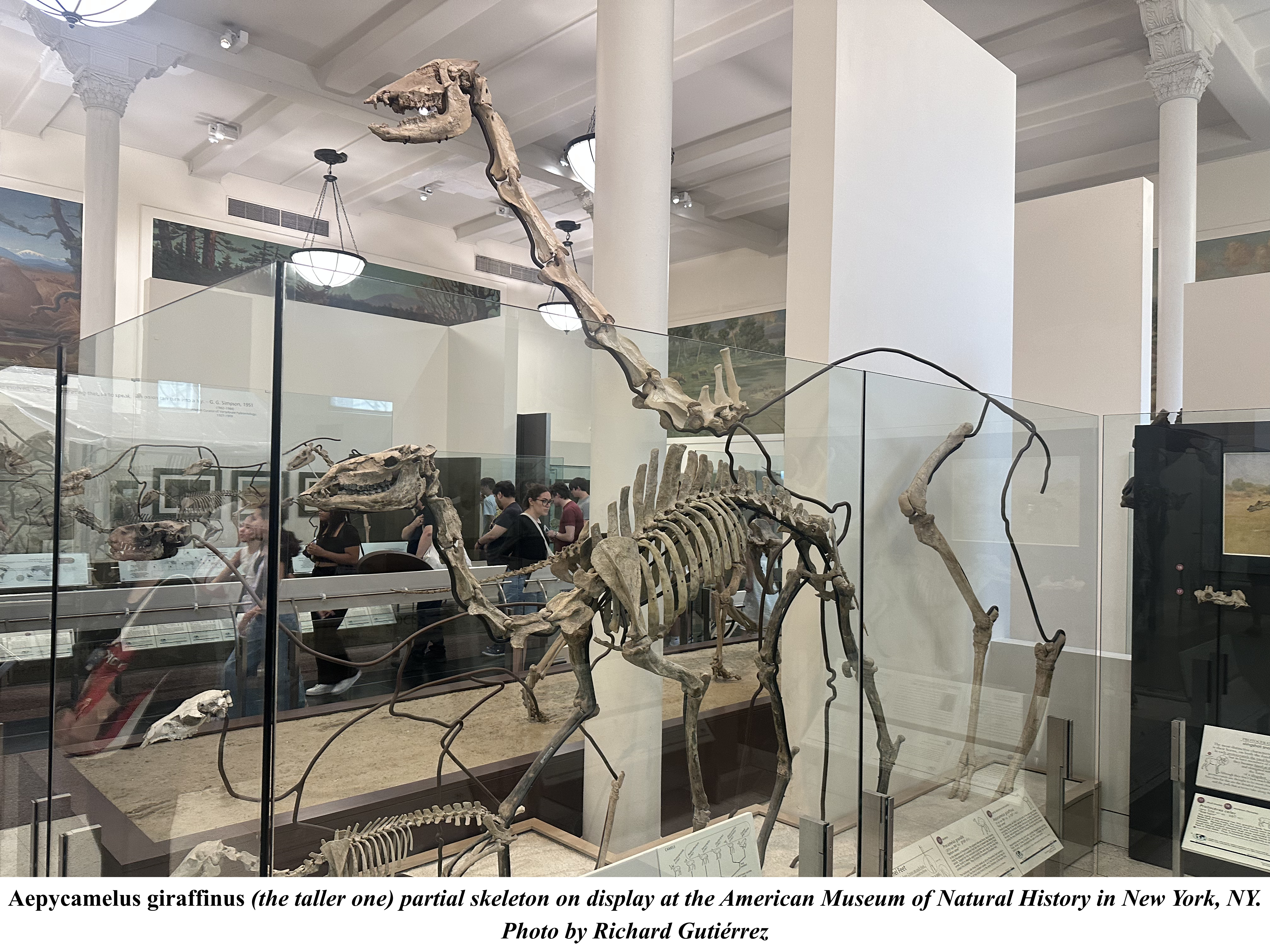
Originally referred to as the now-invalid Alticamelus, Aepycamelus is a highly unique animal. Its neck was far longer than any living camel, allowing the beast to take a more giraffe-like appearance. In fact, both Alticamelus and Aepycamelus mean “tall/high camel.” Adding to its unusually tall appearance were its long, gracile legs. Aepycamelus had a wide geographic range, made up of a variety of different species, but remained entirely within North America. The genus also had a wide temporal range, persisting for around 15 million years. According to Jessica Harrison, who classifies Aepycamelus as ancestral to both tribes, the genus was the first truly giant camel, first appearing 20 million years ago in the Miocene epoch. Harrison also included a map based on pre-1985 discoveries. The different species lived as far east as Florida and as far west as Nevada, with a northern bound of South Dakota. More recent fossil sites include as far west as California and as far north as Montana. Notably, the map has a concentration in the middle of the United States; its adaptations allowed the animal to live successfully on the open prairies of the Miocene. While Aepycamelus itself did not venture south, it still undoubtedly helped lead to the modern lamines.
Then there is Palaeolama. As its name suggests, this camel was a true lamine. While there are a variety of species within this genus, two are particularly noteworthy: P. mirifica and P. major. The former species is the only one known from North America, with most of its fossils having been found in northern Florida. However, it is also known in some localities in both Central and South America. P. major, comparatively, is only known from South America. P. mirifica is also known as the “stout-legged llama,” due to its shorter legs. Interestingly, Bravo and Jiménez posit that the genus actually evolved in South America around 2 million years ago before migrating northward. This idea is somewhat supported by the fact that the last Palaeolama individuals were North American members of P. mirifica, who survived until around 10,000 years ago. However, many researchers still believe that Palaeolama originated in North America before moving southward. Regardless of the true location of the earliest Palaeolama, some sort of lamine moved to South America when Central America connected to South America. Once this link occurred, the Great American Biotic Interchange (GABI) was now possible. Camels, proboscideans, horses, and more moved to the South, while ground sloths, predatory, flightless birds, and large rodents moved to the North. Perhaps another lamine moved south and gave rise to Palaeolama, which then moved back to North America. For the purposes of understanding the modern presence of the tribe, though, it does not matter; Palaeolama still provides insight into an early South American representative of the Lamini tribe.
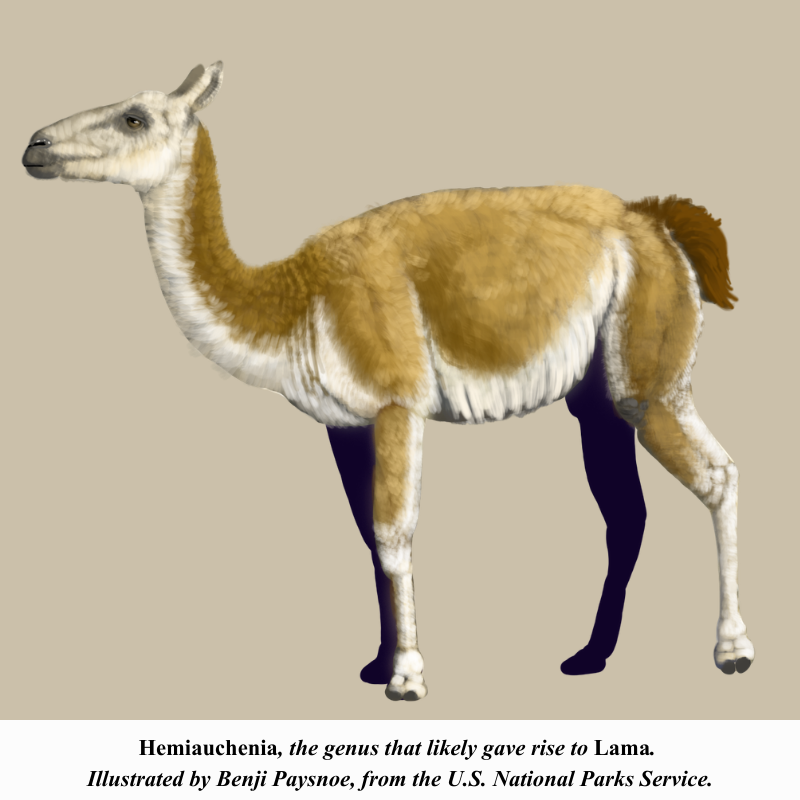
The GABI definitely involved some sort of Lamini genus heading to the South. Among these, Hemiauchenia is special. If Paracamelus is the “grandaddy” of modern (Old World) camels, Hemiauchenia is that ancestral figure to modern lamines. Unlike Palaeolama’s controversial origins, Hemiauchenia is much more conclusively a North American whose individuals gradually drove south, as evidenced by the simple fact that its earliest species evolved 10 million years ago in North America, significantly prior to the occurrence of the GABI. Known from a variety of species, Hemiauchenia is thought to be the direct ancestor of the modern lamines
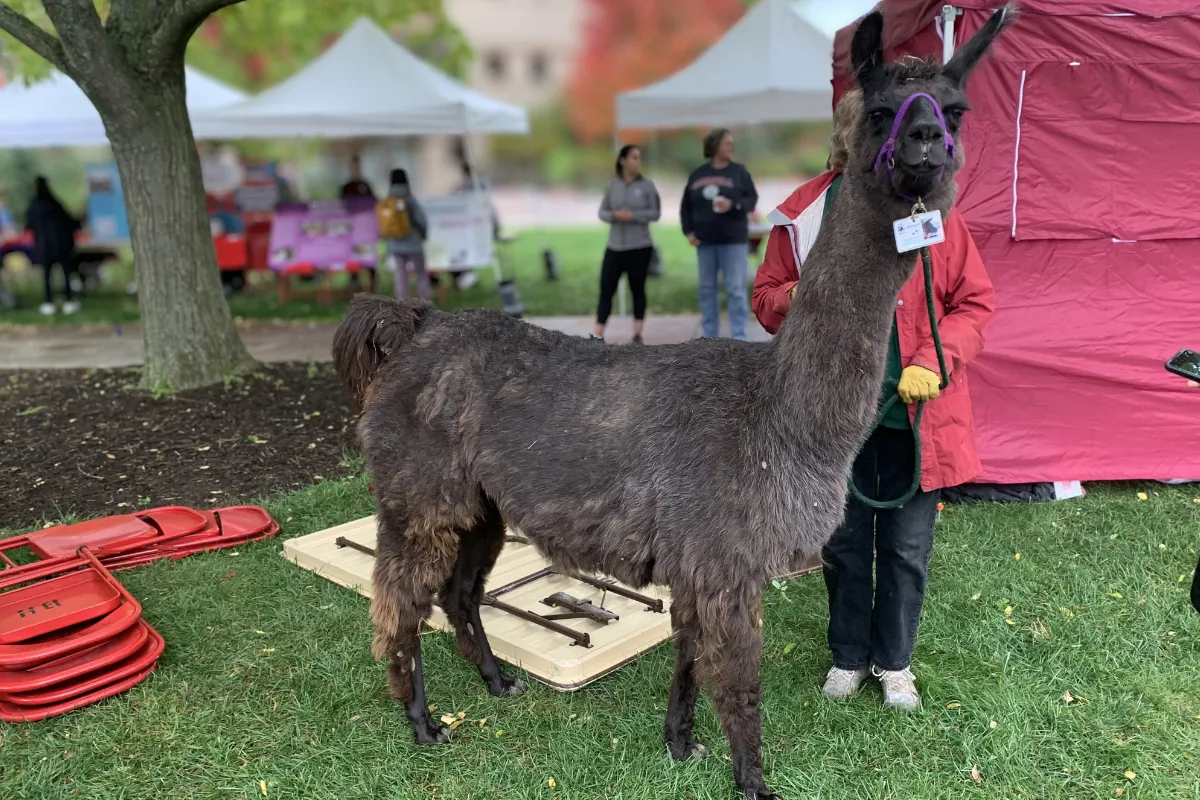
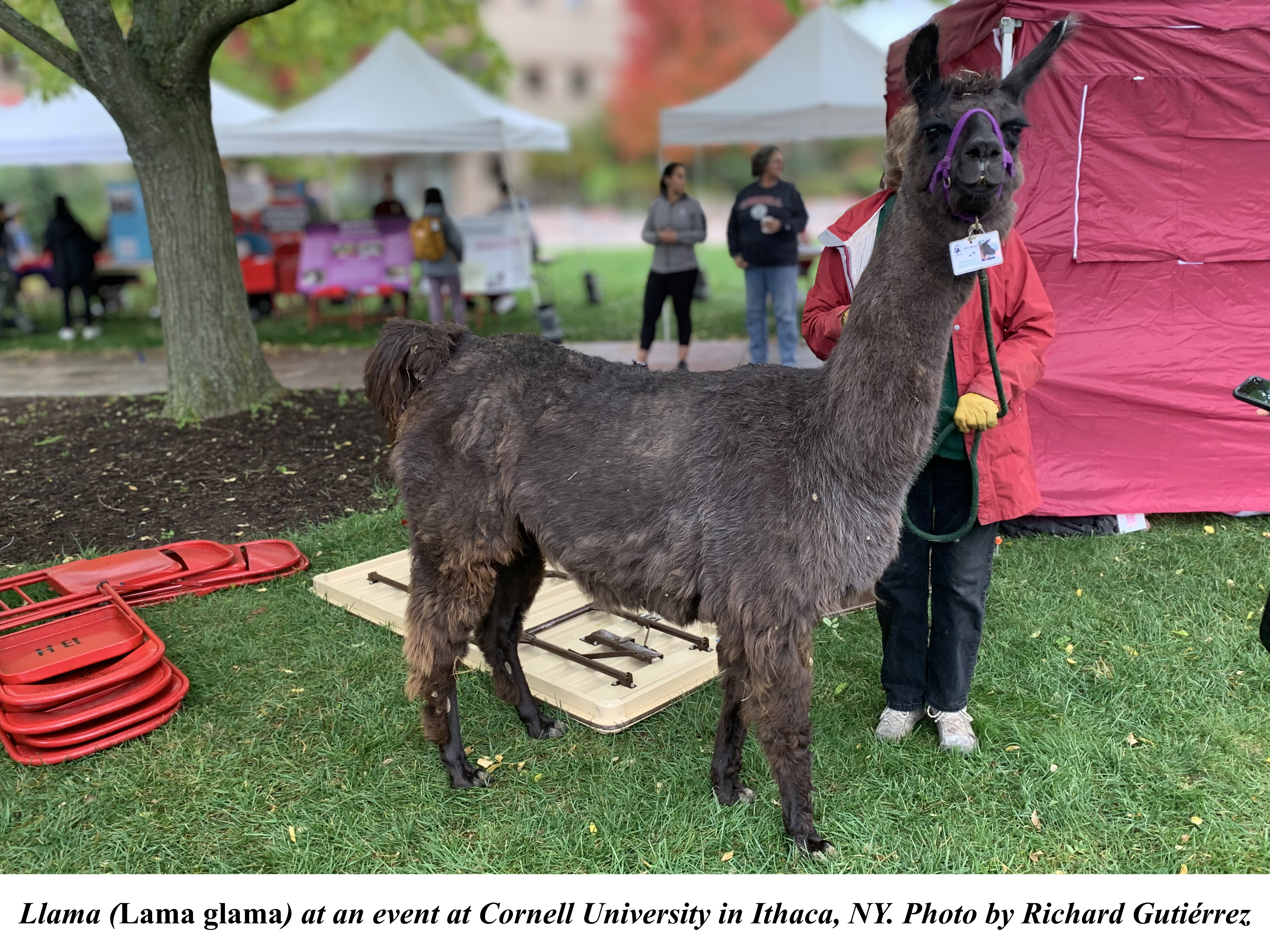
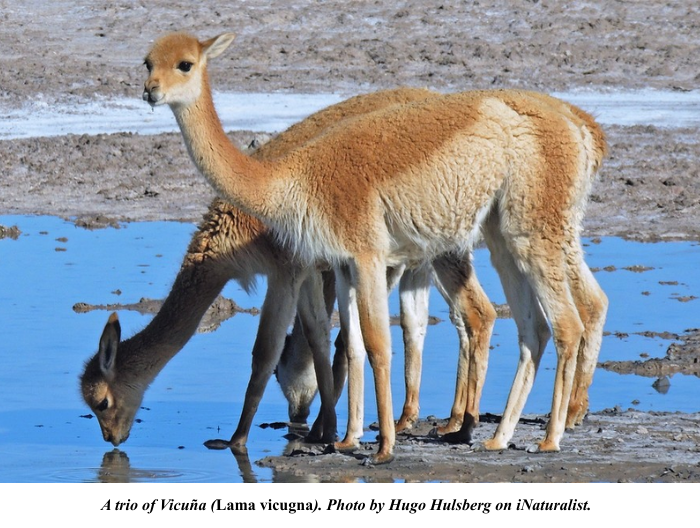
So, Hemiauchenia gave rise to the modern lamines, which consists of just one genus: Lama. In terms of living representatives, the genus comprises the aforementioned llama (Lama glama), alpaca (Lama pacos), guanaco (Lama guanicoe), and vicuña (Lama vicugna). Originally, the llama was actually considered a species of Camelus before moving to its own genus. The taxonomic changes did not end there; while traditionally split into two genera (Lama and Vicugna, more recent views support the one-genus, Lama-only model. Generally, the guanaco is viewed as the wild ancestor of the domestic llama. Fittingly, the two are by far the largest lamines, with llamas specifically topping the lamine world with a maximum weight of around 450 lbs (approximately 200 kg). Similarly, the vicuña is considered to be the wild ancestor of the domestic alpaca. The vicuña is the smallest of the Lama genus, maxing out at 140 lbs (approximately 60 kg). Both the alpaca and llama play important roles as domestic animals in South America. They both produce wool, for instance, though alpaca wool is far more popular for clothes. Additionally, llamas are a very important beast of burden in the continent, along with donkeys.
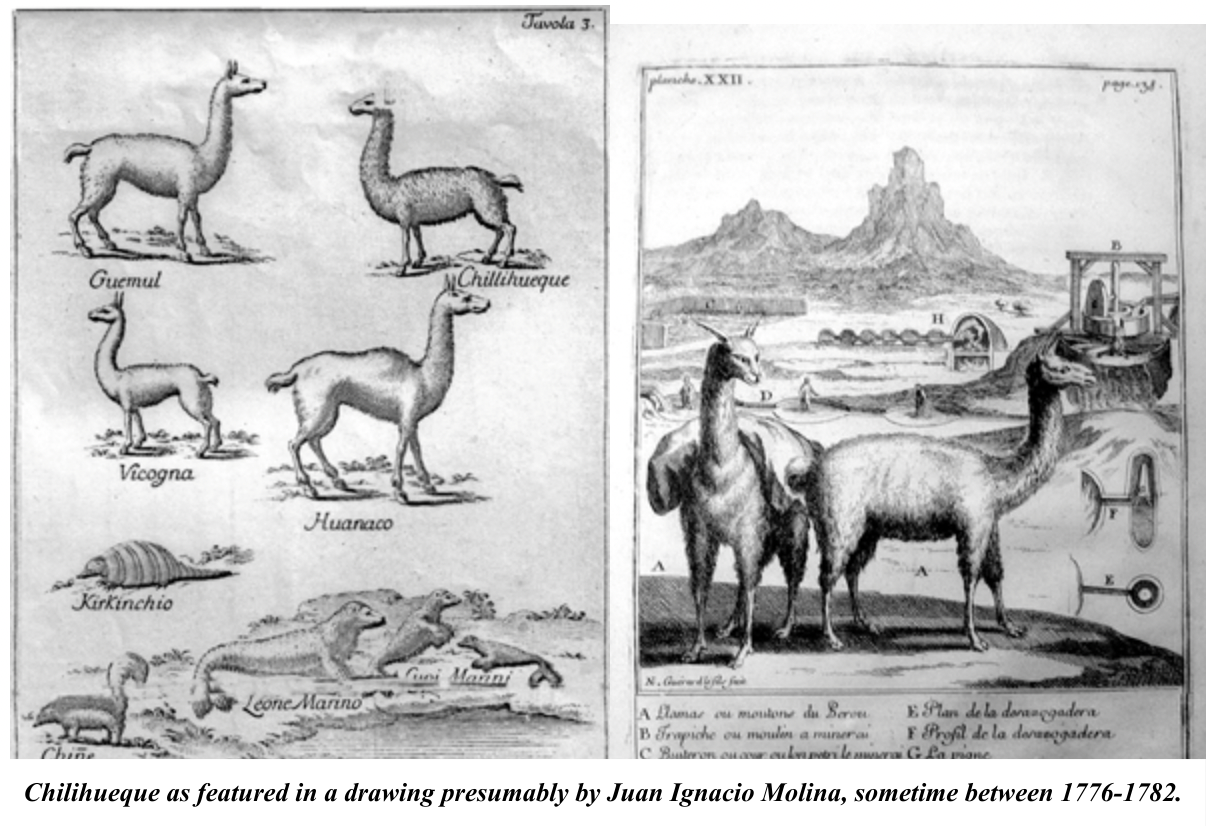
A fifth Lama species is also known, albeit in a controversial manner. The chilihueque, Lama araucana, is a “hypothetical” species. It was a rarer animal than the other lamines and was only scientifically described in the late 1700s (again, as Camelus). Interestingly, the range of the chilihuqeue was limited to Chile, where it was domesticated by the Mapuche people. By the 1800s, it had gone extinct. With no detailed, modern scientific analysis on the chilihuqeue, its true taxonomic nature is still a mystery. In fact, some regard the name “chilihuque” to simply be the Mapuche word for a guanaco. Other explanations include that the animal is a breed of llama that came from northern Chile or just a locally-domesticated guanaco. However, research in 2016 finally provided a more detailed look into this enigmatic creature. Westbury, et al. examined the DNA from all of the living Lama species, as well as the DNA of chilihuques from bones found in Chile’s Isla Mocha. Through their statistical analysis, they concluded that the chilihueque is likely descended from southern Chilean populations of guanacos in some capacity.
These South American classics owe their perseverance and Andean success to the first pioneering lamines who entered the continent millions of years ago. Through careful research, scientists have been able to trace the origination, evolution, and movements of these majestic creatures. Today, they continue as vital aspects of South American culture and beloved global icons, despite their sometimes difficult-to-decipher taxonomic statuses.
Sources:
Bravo-Cuevas, Victor M, and Eduardo Jiménez-Hidalgo. “First Reported Occurrence of Palaeolama Mirifica (Camelidae, Lamini) from the Late Pleistocene (Rancholabrean) of Puebla, Central Mexico.” Boletín de La Sociedad Geológica Mexicana, vol. 67, no. 1, 2015, pp. 13–20, www.scielo.org.mx/scielo.php?pid=S1405-33222015000100002&script=sci_arttext&tlng=en.
Castillo, Andrea G., et al. “Wild South American Camelids (Mammalia, Artiodactyla): A Review of Their Evolutionary and Biogeographic History.” Journal of Vertebrate Paleontology, 17 Feb. 2026, https://doi.org/10.1080/02724634.2026.2616326.
Cui, Peng, et al. “A Complete Mitochondrial Genome Sequence of the Wild Two-Humped Camel (Camelus Bactrianus Ferus): An Evolutionary History of Camelidae.” BMC Genomics, vol. 8, no. 1, 18 July 2007, https://doi.org/10.1186/1471-2164-8-241.
Fan, Ruiwen, et al. “Genomic Analysis of the Domestication and Post-Spanish Conquest Evolution of the Llama and Alpaca.” Genome Biology, vol. 21, no. 1, 2 July 2020, https://doi.org/10.1186/s13059-020-02080-6.
Harrison, Jessica. “Giant Camels from the Cenozoic of North America.” Smithsonian Contributions to Paleobiology, vol. 57, 1985.
O’Dea, Aaron, et al. “Formation of the Isthmus of Panama.” Science Advances, vol. 2, no. 8, 17 Aug. 2016, p. e1600883, https://doi.org/10.1126/sciadv.1600883.
Westbury, Michael, et al. “First Complete Mitochondrial Genome Data from Ancient South American Camelids - the Mystery of the Chilihueques from Isla Mocha (Chile).” Scientific Reports, vol. 6, no. 1, 8 Dec. 2016, www.nature.com/articles/srep38708.com, https://doi.org/10.1038/srep38708.
Photo Sources:
https://www.nps.gov/articles/000/the-camels.htm
https://www.inaturalist.org/guide_taxa/1939404
https://www.scielo.cl/scielo.php?pid=s0718-04622007000100006&script=sci_arttext#f27
All other photos by Richard Gutiérrez


Subscribe to Scooby's Prehistory Archives
Never miss a new chance to learn about prehistory!
Copyright 2026. Richie The Dino. All Rights Reserved.